

Page Updated on October 8, 2026
The StockZuse Research Strategy provides a structured method for identifying individual stocks that may warrant further research.
Rather than beginning with individual stocks and immediately trying to determine whether they are good investments, the strategy uses a structured research workflow to progressively narrow the investment universe.
The process begins by identifying areas of the stock market demonstrating strong recent performance and then narrows those areas to individual Company Candidates using defined screening criteria and independent research.
An Open Research Strategy
The StockZuse Research Strategy is an open research process. The steps used to identify and narrow potential investment candidates are documented, including the data sources, screening criteria, ranking procedures, and decision rules used at each stage.
The objective is not to produce an unexplained list of stock ideas. Investors can see how candidates progress through the Research Strategy, understand the criteria and research information being applied, and independently evaluate the process.
See the research. See the methodology. Make your own decision.
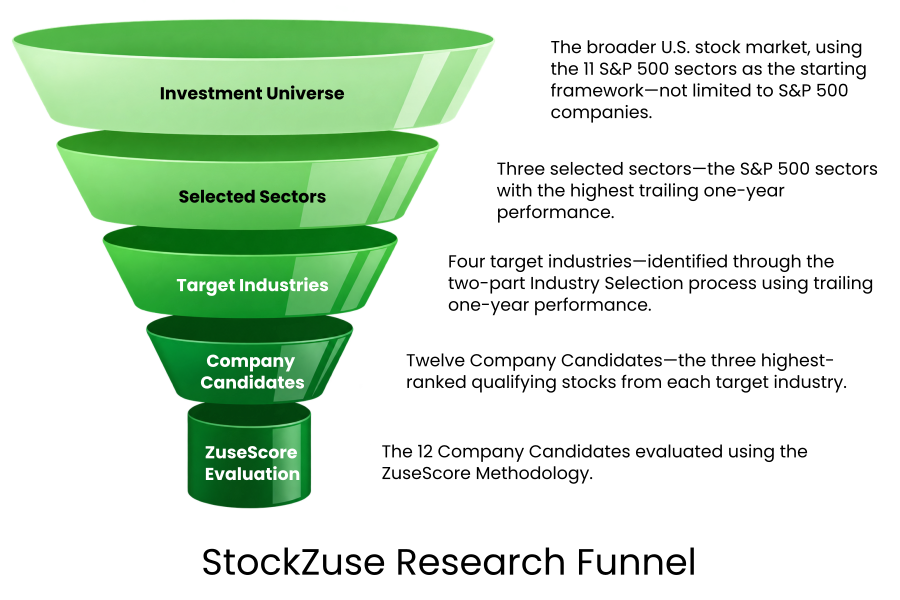
The StockZuse Research Funnel
The StockZuse Research Funnel illustrates how the Research Strategy progressively narrows the investment universe from the broader U.S. stock market to individual Company Candidates for ZuseScore evaluation.
The funnel contains five sections representing the research universe at successive stages of the process. Four Research Strategy steps move the research from one section of the funnel to the next.
The process begins with the 11 S&P 500 sectors as a framework for identifying areas of recent market leadership.
This does not mean that the Research Strategy is limited to companies in the S&P 500. The S&P 500 sectors provide the starting framework for Sector Selection. When the process reaches Stock Screening, companies do not need to be members of the S&P 500 to qualify.
Step 1 – Sector Selection
The Research Strategy begins by identifying areas of broad market leadership.
The 11 S&P 500 sectors are ranked by trailing one-year performance, and the three highest-performing sectors are selected.
This answers the first question: Where is the market currently showing the strongest broad market leadership?
Result: 11 S&P 500 sectors → 3 Selected Sectors
Step 2 – Industry Selection
Market leadership can be concentrated within particular industries and does not need to be distributed evenly among sectors.
Industry Selection uses a two-part ranking process.
Part 1 – Preliminary Industry Ranking
The industries within each of the three Selected Sectors are ranked separately by trailing one-year performance.
For each Selected Sector, the four highest-performing eligible industries are retained. If a sector contains fewer than four eligible industries, all eligible industries from that sector are retained.
The industries retained from the three Selected Sectors are then combined into a single Aggregate Industry Group.
Part 2 – Aggregate Industry Ranking
The industries in the Aggregate Industry Group are ranked together by trailing one-year performance, regardless of sector. The Top 4 industries overall become the Target Industries for Stock Screening.
A Selected Sector is not guaranteed representation among the Target Industries. Multiple Target Industries—or all four—may come from the same sector.
Result: 3 Selected Sectors → Preliminary Industry Ranking → Aggregate Industry Group → 4 Target Industries
Step 3 – Stock Screening
The Research Strategy next moves from industries to individual companies.
Each of the four Target Industries is screened separately using the same defined screening criteria. These criteria establish minimum company eligibility based on factors including company size, security type, Free Cash Flow, Revenue Growth, and headquarters location.
Stocks that meet the screening criteria are then ranked within their respective industries using the LSEG StarMine Equity Summary Score (ESS), available through Fidelity. The three highest-ranked qualifying stocks from each Target Industry become Company Candidates.
ESS provides a forward-looking indication of research sentiment toward a stock by combining the ratings of independent research providers. Within the StockZuse Research Strategy, ESS is used only to rank stocks that have already met the defined screening criteria.
ESS is used to rank the qualifying stocks; it is not a minimum eligibility requirement and is not a component of ZuseScore.
Result: 4 Target Industries → 12 Company Candidates
Step 4 – ZuseScore Evaluation
The final step evaluates each Company Candidate using the ZuseScore Methodology.
ZuseScore objectively evaluates Business Quality using defined company financial metrics, formulas, and scoring rules. Each Company Candidate is evaluated using the same documented methodology.
Market leadership and independent research helped identify the Company Candidates, but they are not components of ZuseScore.
The purpose of this step is not to tell an investor whether to buy, sell, or hold a stock. It provides an objective financial evaluation that can be examined alongside additional research and the investor’s own decision-making process.
The StockZuse Research Strategy ends with ZuseScore Evaluation.
A Structured, Repeatable Process
A primary goal of the StockZuse Research Strategy is to make candidate discovery and evaluation structured, transparent, and repeatable.
Each stage has a defined purpose:
- Sector Selection identifies areas of broad market leadership.
- Industry Selection progressively narrows the industries within the Selected Sectors to identify the four strongest-performing Target Industries.
- Stock Screening applies consistent eligibility criteria, ranks the qualifying stocks using independent research sentiment, and identifies the Company Candidates.
- ZuseScore Evaluation objectively evaluates the Business Quality of each Company Candidate using defined financial metrics, formulas, and scoring rules.
The process separates candidate discovery from company evaluation. Market performance determines where to research, defined screening criteria establish which companies qualify, and independent research sentiment is used to determine which qualifying companies become Company Candidates. ZuseScore then objectively evaluates the Business Quality of those companies independently of the criteria used to identify them.
The purpose is not to predict what the market or an individual stock will do next. It is to provide a documented and repeatable framework for identifying and evaluating companies that may warrant additional research.
Market leadership identifies where to research. Stock screening establishes which companies qualify. Independent research helps identify the Company Candidates. ZuseScore objectively evaluates their Business Quality.
Beyond the Research Strategy
The Research Strategy is designed to identify and evaluate companies that may warrant further research. It does not make the investment decision.
After ZuseScore Evaluation, investors may consider valuation, current stock price, company and industry risks, recent developments, SEC filings, analyst opinions, personal investment objectives, and other information they consider relevant.
These considerations are intentionally outside the structured Research Strategy and are discussed separately in Beyond the Research Strategy.