

Page Updated on October 9, 2026
Industry Selection is the second step of the StockZuse Research Strategy. Its purpose is to identify where the strongest industry-level market leadership is concentrated within the three sectors selected during Sector Selection.
Industry Selection uses a two-part ranking process.
First, the industries within each of the three selected sectors are ranked separately by trailing one-year performance, and the Top 4 industries from each sector are retained.
Second, the retained industries are combined into a single aggregate group and ranked together by trailing one-year performance. The Top 4 industries overall become the Target Industries and advance to Stock Screening.
The first ranking determines which industries enter the aggregate group. The second ranking determines which industries become Target Industries.
Industry Selection helps answer the next question in the Research Strategy:
Where within the leading sectors is industry-level market leadership currently strongest?
The Fidelity Sector Tool
Industry Selection uses the same Fidelity Sector Tool used for Sector Selection.
The Fidelity Sector Tool is available at:
digital.fidelity.com/prgw/digital/research/sector
As of this writing, the Fidelity Sector Tool is available without requiring a Fidelity account.
The Sector Tool is particularly useful to the StockZuse Research Strategy because it provides both sector and industry research within the same tool and classification structure.
The three sectors identified during Sector Selection can therefore be examined directly to identify their underlying industries. There is no need to translate the selected Fidelity sectors into industry categories provided by another research source.
This common classification structure helps keep the transition from Sector Selection to Industry Selection simple and repeatable.
Fidelity provides the research tool and classification framework. StockZuse provides the Research Strategy rules for using that information.
The Two-Part Selection Process
Industry Selection uses a two-part ranking process.
First, industries within each of the three selected sectors are ranked separately by trailing one-year performance, and the Top 4 industries from each sector are retained.
Second, the retained industries are combined into a single aggregate group and ranked together by trailing one-year performance. The Top 4 industries overall become Target Industries and advance to Stock Screening.
The first ranking determines which industries enter the aggregate group. The second ranking determines which industries become Target Industries.
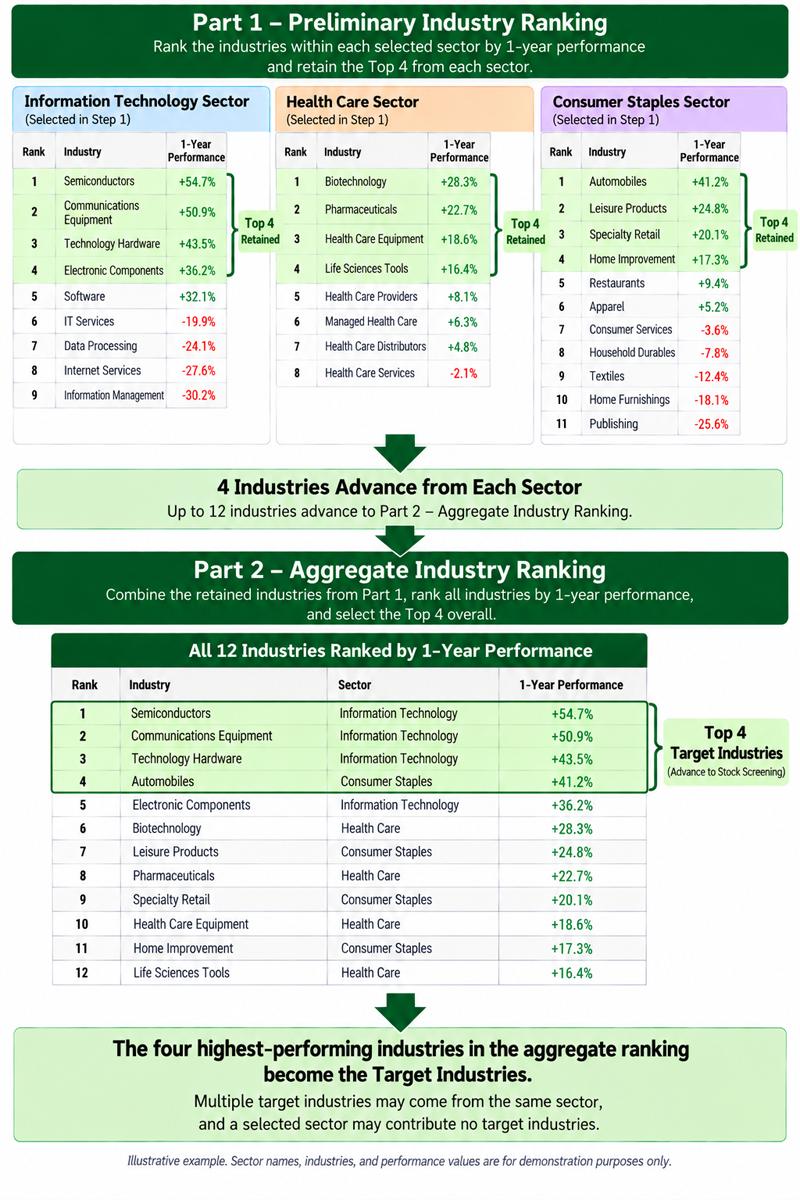
Part 1 – Preliminary Industry Ranking
The first part of Industry Selection identifies the four highest-performing industries within each of the three selected sectors.
Open the Fidelity Sector Tool using this link:
Below the Sector performance section, the Fidelity Sector Tool displays a separate expandable block for each S&P 500 sector.
Using the three sectors identified during Step One, Sector Selection, find the first selected sector.
Click the arrow to the left of the sector name to expand it and display its detailed information.
Once expanded, scroll to the section titled Industries in this sector.
This table displays the industries Fidelity assigns to that sector and their performance over several time periods.
For the StockZuse Research Strategy, use the 1-year performance column.
Click the 1-year column heading as necessary to sort the industries from highest performance to lowest performance.
Identify and record the four industries with the highest 1-year performance, along with their 1-year performance values. If a sector contains fewer than four eligible industries, all eligible industries from that sector are retained.
Repeat this procedure for each of the other two sectors selected during Sector Selection.
At the completion of Part 1, you will have retained up to four industries from each of the three selected sectors, producing an aggregate candidate pool of up to 12 industries.
The illustration should show the three selected sectors separately, their industries ranked by 1-year performance, and the Top 4 industries from each sector advancing.
Why Retain Only Four Industries From Each Sector?
The final objective of Industry Selection is to identify the four highest-performing industries overall. For that reason, only the four highest-performing industries within each selected sector need to be carried forward.
Retaining only the Top 4 industries from each selected sector simplifies the process.
This preliminary ranking is only a narrowing step. It does not reserve a position for any sector among the final Target Industries.
Part 2 – Aggregate Industry Ranking
After completing the preliminary ranking for all three selected sectors, combine the retained industries into a single aggregate group.
If each selected sector contains at least four eligible industries, the aggregate group will contain 12 industries. A sector with fewer than four eligible industries contributes only the industries available.
Once the aggregate group has been created, the industries are no longer evaluated separately by sector.
Rank the entire aggregate group by trailing one-year performance, from highest to lowest.
Identify the four industries with the highest 1-year performance in the aggregate ranking.
These four industries become the Target Industries.
The illustration should show the industries retained during Part 1 being combined into one aggregate group, ranked together, and narrowed to the Top 4 Target Industries.
The aggregate ranking does not allocate positions to individual sectors. Multiple Target Industries may come from the same sector, and a selected sector may contribute no Target Industries.
All four Target Industries may come from the same sector if they occupy the four highest positions in the aggregate ranking.
Why Use an Aggregate Ranking?
Sector Selection identifies broad areas of the market demonstrating strong recent performance. The preliminary ranking in Part 1 then identifies the industries within those sectors that could potentially qualify among the four strongest industries overall.
The aggregate ranking serves a different purpose.
By combining the retained industries into a single group, the Research Strategy compares their performance directly rather than requiring each selected sector to contribute a Target Industry.
This allows the final selection to reflect where industry-level market strength is actually concentrated.
Market leadership does not need to be distributed evenly among sectors. One selected sector may contain several of the strongest-performing industries, while another selected sector may contain none that rank among the final four.
The StockZuse Research Strategy does not impose sector representation or diversification during Industry Selection. The four Target Industries are determined solely by their position in the aggregate 1-year performance ranking.
Industry Selection remains a candidate-discovery filter. Selection as a Target Industry does not mean that StockZuse considers the industry a good investment or expects it to continue outperforming.
It determines where the Research Strategy will look for individual company candidates during Stock Screening.
Why Use Trailing One-Year Performance?
Industry Selection uses the same trailing one-year performance period used during Sector Selection.
Using the same measurement period provides consistency between the first two stages of the Research Strategy. Sectors and industries are evaluated using a common time horizon rather than changing the measurement period as the research universe becomes narrower.
Fidelity’s Industries in this sector table provides several performance periods. The StockZuse Research Strategy deliberately uses only 1-year performance for Industry Selection.
The Research Strategy does not combine one-year performance with daily, five-day, one-month, three-month, year-to-date, five-year, or ten-year performance when selecting industries.
This continues the same mechanical approach established during Sector Selection: one research source, one measurement period, and defined ranking rules.
Trailing one-year performance identifies current market leadership. It is not a prediction that the highest-performing industries will continue to outperform.
Past performance does not guarantee future results.
Why Do Four Industries Advance?
The StockZuse Research Strategy retains the four highest-performing industries in the aggregate ranking.
Four is a defined narrowing rule of the Research Strategy. Applying the same rule each time prevents the number of Target Industries from being changed based on opinions, forecasts, or subjective judgments about which industries appear attractive.
An industry does not need to exceed a particular performance percentage to qualify. The industries in the aggregate group are ranked relative to one another, and the four highest-ranked industries advance.
There is no allocation of the four positions among the three selected sectors. The aggregate ranking alone determines which industries advance.
As a result, the four Target Industries may represent all three selected sectors, two selected sectors, or a single selected sector.
Information Not Used for Industry Selection
Fidelity’s Sector Tool contains considerably more information than is required for Industry Selection.
The StockZuse Industry Selection rules do not use shorter- or longer-term performance periods, sector market capitalization, market weight, analyst information, charts, news, individual company information, or investment-product information available through the Sector Tool.
Those items may be useful for other types of research, but they do not affect which industries advance under the StockZuse Research Strategy.
For this stage, selection is determined solely by trailing one-year performance—first to identify the Top 4 industries within each selected sector, and then to identify the Top 4 industries in the aggregate group.
What the Results Mean
Selection as one of the four Target Industries does not mean that StockZuse considers the industry a good investment or expects it to continue outperforming.
It means only that the industry currently ranks among the four highest-performing industries in the aggregate group under the defined Industry Selection rules.
Likewise, an industry that does not become a Target Industry has not failed an investment-quality test. It simply does not advance during that Research Strategy run.
A sector selected during Sector Selection is also not guaranteed representation among the Target Industries. Its purpose was to establish eligibility for Industry Selection, not to reserve a position in the final industry ranking.
Market leadership changes over time. Repeating the Research Strategy later may therefore produce different Target Industries.
Industry rankings are used for candidate discovery, not portfolio management or as buy or sell signals.
Industry Selection Result
At the completion of Industry Selection, the Research Strategy has narrowed the industries within the three selected sectors through a two-part ranking process:
3 selected sectors → Top 4 industries from each sector → aggregate group of up to 12 industries → Top 4 Target Industries
No individual companies have been selected or evaluated at this stage.
The four Target Industries now advance to Stock Screening, where objective Baseline Screening Criteria are applied to identify individual companies that meet the minimum eligibility requirements of the Research Strategy.