

Page Updated on September 20, 2026
Overview
Latest Gross Margin measures the percentage of a company’s revenue that remains after accounting for the direct costs associated with producing its goods or services.
Gross Margin provides a measure of the profitability of a company’s core products or services before operating expenses, interest, and taxes are considered.
Formula
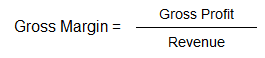
For example, if a company reports Gross Profit of $43.67 billion and Revenue of $87.03 billion, StockZuse calculates a Gross Margin of approximately 50.18%.
How StockZuse Uses the Metric
StockZuse uses Latest Gross Margin as a Business Quality metric within the ZuseScore.
The metric measures how much of a company’s revenue remains as gross profit after the direct costs of producing its goods or services.
Gross Margin is intentionally scored with diminishing rewards at higher margins. This recognizes the weakness of very low gross margins without allowing companies in structurally high-margin industries to disproportionately influence the ZuseScore.
ZuseScore Point System
Latest Gross Margin contributes a maximum of 8 points to the ZuseScore.
| Latest Gross Margin | Points |
|---|---|
| 50% or more | 8 / 8 |
| 40% to less than 50% | 7 / 8 |
| 30% to less than 40% | 6 / 8 |
| 20% to less than 30% | 4 / 8 |
| 10% to less than 20% | 2 / 8 |
| 5% to less than 10% | 1 / 8 |
| Below 5% | 0 / 8 |
If matching annual Gross Profit and Revenue data are unavailable, the metric is not scored.
Interpretation
A positive Gross Margin indicates that revenue exceeded the direct costs reflected in the company’s reported gross profit.
Higher gross margins indicate that a larger percentage of revenue remains after those direct costs. Lower gross margins indicate that a greater portion of revenue is consumed by the direct costs associated with producing the company’s goods or services.
Latest Gross Margin should be considered together with the other ZuseScore metrics rather than interpreted in isolation.
Limitations
Gross Margin can vary substantially between industries because companies have different business models, production costs, pricing structures, and accounting classifications.
For example, a software company may naturally operate with a substantially different gross margin than a manufacturer or retailer. Gross Margin therefore should not be used by itself to compare the overall financial quality of companies with very different business models.
This industry variation is one reason the ZuseScore limits Gross Margin to 8 points and uses diminishing scoring rewards at higher margins.
Data Used
StockZuse uses annual financial data from the same fiscal period:
Gross Profit — the company’s reported gross profit for the latest annual period.
Revenue — the company’s reported revenue for the corresponding annual period.
These are the same underlying values displayed in the Values Used section of Metric Detail.